
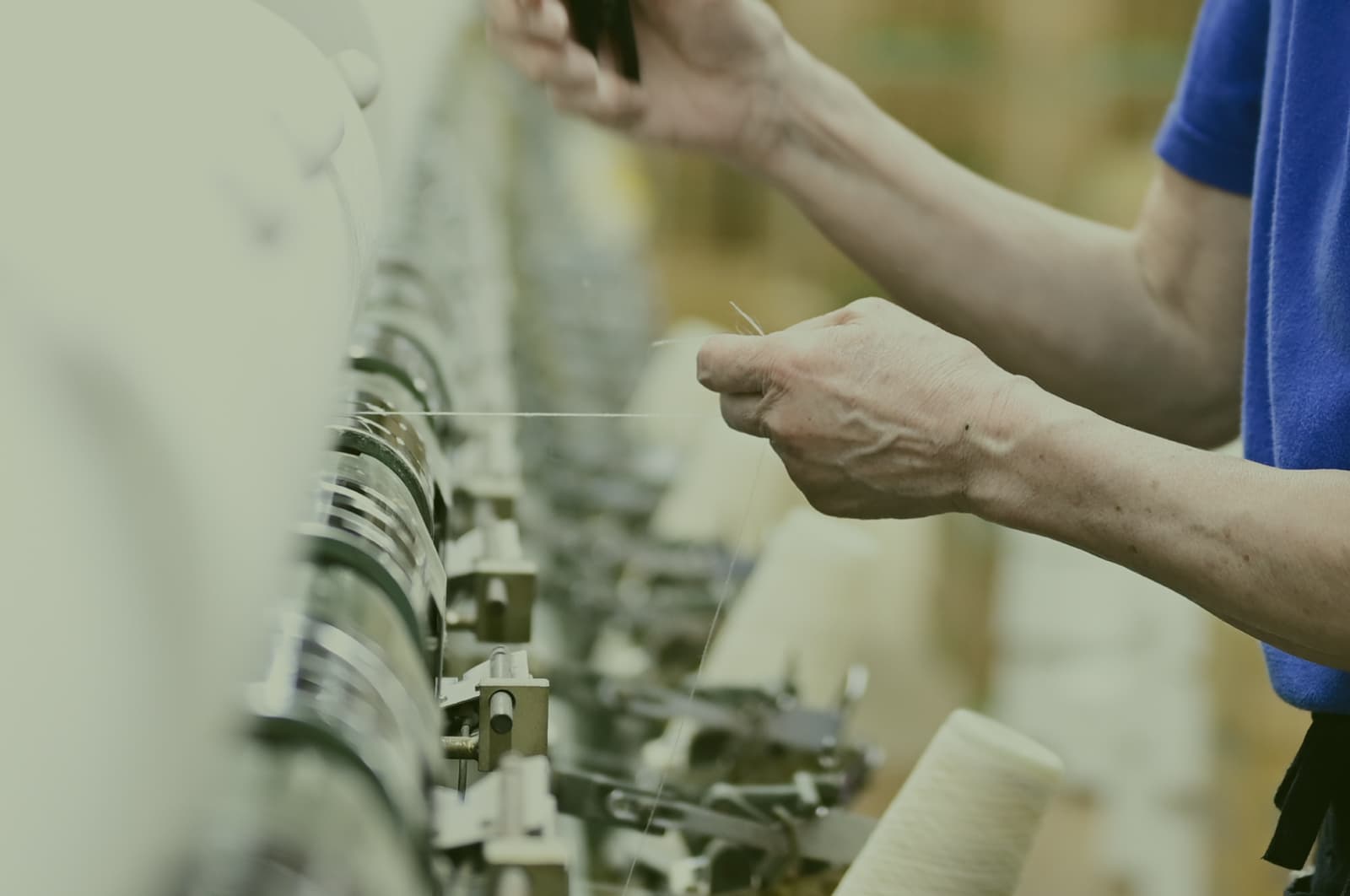
Decarbonization and Circular Manufacturing
More than two decade of energy-saving investment has cut our electricity consumption by 22.8%. This commitment to energy efficiency coupled with our weaving expertise—including ultra-high-density textiles—lets us make fabrics with a lighter environmental footprint.
- What a Textile Mill Should Show the World: Transparency, in Numbers
- Responsibility
- The New Question: How Was It Made?
- It Started Not with “Eco,” but with an Engineer’s Hunch That Something Was Off
- Our Results in Numbers
- Just by Weaving: Saving 30 Tons of Water and Cutting CO2
- Keeping Our Textile Region Alive: Turning Skill into Technology
- Next: Manufacturing That Comes Full Circle
- Message from the President
- To Our Partners (Brands and Designers)
- References (External Links)
What a Textile Mill Should Show the World:
Transparency, in Numbers
The textile industry is facing hard questions. How much energy went into making this fabric? And how will you bring that number down? We can answer both—with a proven track record to back it up.
On this page, we share the two things that matter most to us:
- Transparent manufacturing
- Showing, in numbers, what we use and how much energy it takes.
- Responsible manufacturing
- Cutting wasteful energy and resources wherever we can.
Responsibility
We take responsibility for how things are made.
Our goal is a process that is simple and makes sense.
- Practical
- Intuitive and easy to use.
- Lean
- Using only as much energy and material as the job needs.
- Clear
- Able to explain, in numbers, what we used and how we made it.
- Kind to the environment
- A light footprint, both in production and after use.
These principles share the same roots as the three promises we have long made:
- Peace of mind
- Zero complaints, so our customers can take on their next challenge with confidence.
- Sustainability
- Using less power and eliminating product waste, toward a low-energy society.
- Passing on our craft
- Distilling our weaving know-how into a simple, teachable form and handing it down to the next generation.
The New Question: How Was It Made?
The massive, hidden footprint behind every garment
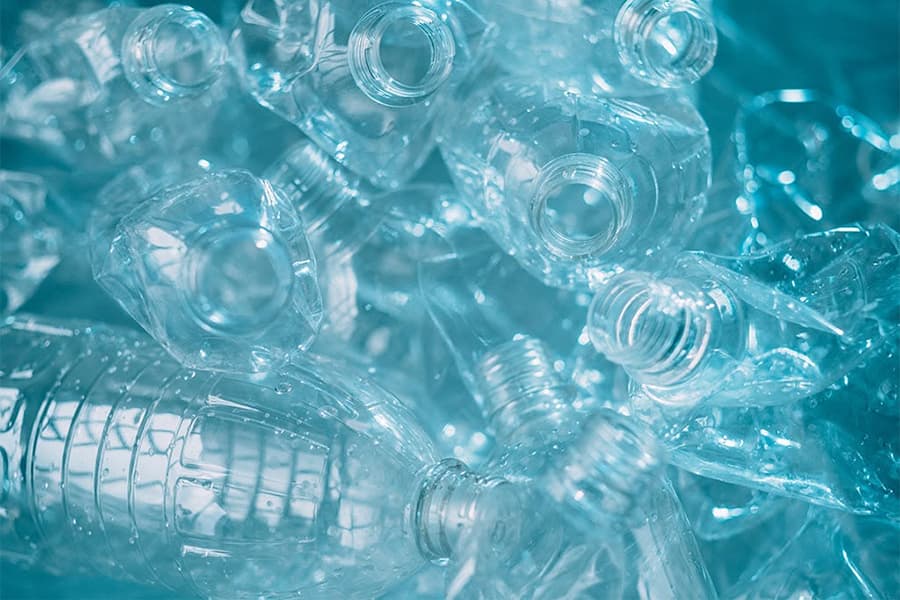
According to Japan’s Ministry of the Environment, making a single piece of clothing emits about 25.5 kg of CO2—about the same as 255 half-liter plastic bottles—and uses an estimated 2,300 liters of water, enough to fill about 11 bathtubs.*
*Source: Ministry of the Environment, “Sustainable Fashion” (Japanese)
A mill that can answer in numbers
In 2024, Japan’s Ministry of Economy, Trade and Industry (METI) published its Guidelines for Environmental Information Disclosure in the Textile and Apparel Industry. They call for implementing information disclosure by Japan’s major apparel companies by around 2026, and a 100% disclosure rate among leading apparel companies by 2030.
The guidelines also state plainly that small and mid-sized weaving and knitting companies should expect requests—from overseas apparel companies and others—for data on the greenhouse gas emissions and water use involved in their production.
For brands to disclose the environmental impact of their products, they need data from the mills that make their fabrics. Our mill is ready to provide those numbers, and we have the reduction record to show for it.
- Source: METI, Guidelines for Environmental Information Disclosure in the Textile and Apparel Industry (1st Edition) (Japanese)
- Source: METI, Guidelines for Environmentally Conscious Design of Textile Products (Japanese)
- Source: Small and Medium Enterprise Agency, 2024 White Paper on Small and Medium Enterprises in Japan, Section 5: GX (Japanese)
It Started Not with “Eco,”
but with an Engineer’s Hunch That Something Was Off
Our energy-saving journey began with a compressor that kept mysteriously shutting down every summer—and a nagging feeling that nobody was thinking about energy efficiency. It was never about “saving the planet.”
An Energy-Saving Story:
All That Electricity, Going to Waste
Motohiko Sakaue, President
Licensed Third-Class Chief Electrical Engineer; working on the mill’s energy efficiency since 2003
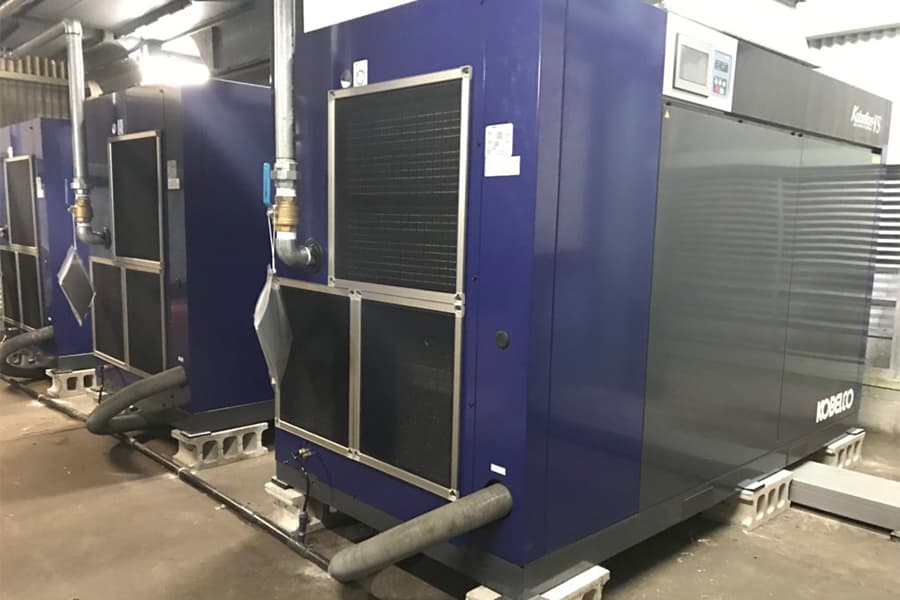
The compressor that quit every summer.
When I first joined the company in 1998, the compressor would overheat and shut down every summer. If we didn’t catch it quickly, the looms ran short of air and churned out mountains of defective fabric. Why was the compressor overheating? Because the compressor room was hot. Why was the room hot? Because hot exhaust was flowing right back in. Forced to compress that hot air, the compressor would simply give up, as if to say, “I can’t take it anymore.” When I asked, “Isn’t the airflow going the wrong way?” the answer was, “That’s just how it’s done!”—end of discussion. Fine, I thought. I’ll find out for myself.
Once you understand electricity, you see the waste.
Earning my electrical engineering license gave me a fundamental understanding of our equipment and machinery, and I learned to run it efficiently. Once you know what to look for, you notice electricity leaking out all over the plant. What a waste. The efficiency of our substation equipment, the gauge and length of the power lines, where the compressors were placed, the temperature and path of the air, how compressor exhaust heat was handled—every one of those fundamentals was a mess.
No budget? Build it by hand!
Saving energy always involves management decisions, because the big fixes require big investments. My proposal to overhaul those fundamentals, however, met blank stares. While I waited for the right moment—and partly to keep my own frustration in check—I switched to squeezing out savings around the building and looms instead.
Planting trees and ivy, close to tears.
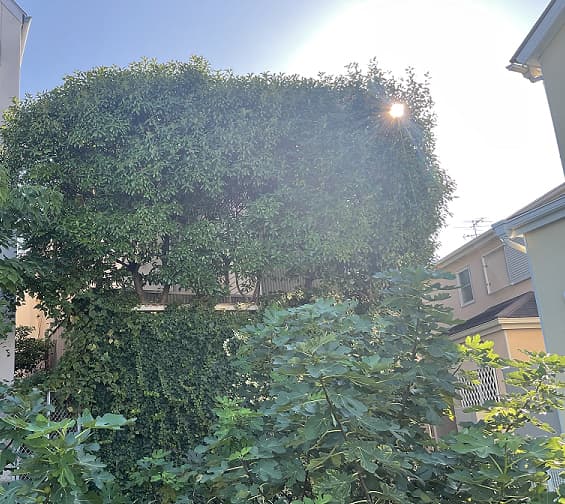
At the suggestion of my wife, I planted red-tip photinia and ivy outside the compressor room to cool it naturally. She had read about the green curtain effect of ivy on urban buildings and thought it could help to reduce our company’s high electricity bill. I felt nothing but gloom, however: the emptiness of having no better option, mixed with anger at how many years those trees would take to grow. Today it is one of our most praised initiatives, but back then it felt like a hopeless chore.
One ¥30,000 loom part, every month.
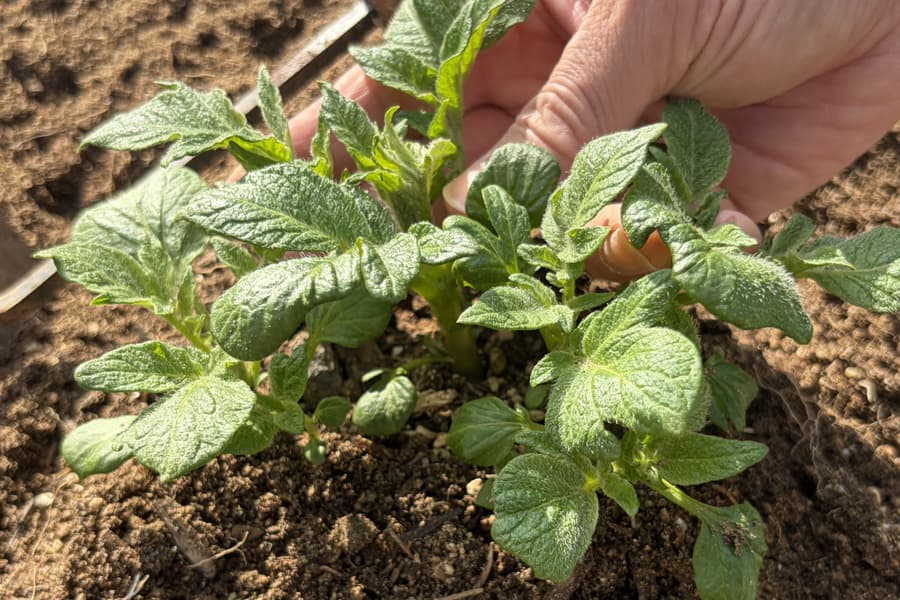
Still, I had to do what I could. Without losing heart, I bought one ¥30,000 part a month within my own discretionary budget, installed it, then bought and installed another. Before I knew it, our electricity bill had dropped by about ¥70,000 a month. “Yes!” Encouraged, I raised my energy-saving budget—and the results kept coming.
Cutting ¥70,000 from the electricity bill
is worth more than adding ¥70,000 in sales
I didn’t know the first thing about finance back then, so energy saving taught me a great deal. One lesson: cutting ¥70,000 from the electricity bill is worth more than adding ¥70,000 in sales. So whenever I had more money to work with, I put it into energy saving, and when that freed up even more funds, I reinvested it—a loop I repeated over and over. With time the results added up, and I was finally able to fix the fundamentals I had wanted to tackle all along.
Energy saving never ends!
Working on this since 2003 has given me real expertise, and the results have kept coming. Speaking as an energy-efficiency specialist raised in a textile mill: there is no finish line. With knowledge and funding, you can always save more. Energy saving around the looms also improves efficiency, quality and versatility. I can write this with confidence: energy-saving technology is weaving technology.
Three Systems for Optimizing Energy—
in Harmony with Nature
Our 22.8% cut in electricity consumption is the sum of three systems working together.
① Starting with a natural cooling system.
Cutting power consumption starts at the very outside of the building. Compressors account for 80% of our plant’s electricity use. To make them more efficient—by feeding them denser intake air—we began a “first-generation” effort in 2003, planting trees along the air intake path and training ivy up the walls. Today, this would be called a nature-based solution. In 2008 we expanded to the “second generation.” By lowering ground and wall temperatures with natural shade, it has grown into a small ecosystem that is home to a multitude of insects and lizards—and it still quietly supports the heart of our plant. Starting from this natural cooling system, we have cut heat, pressure and energy losses everywhere, from hot-exhaust recovery to tanks and piping.
② Visualization and a continuous improvement loop.
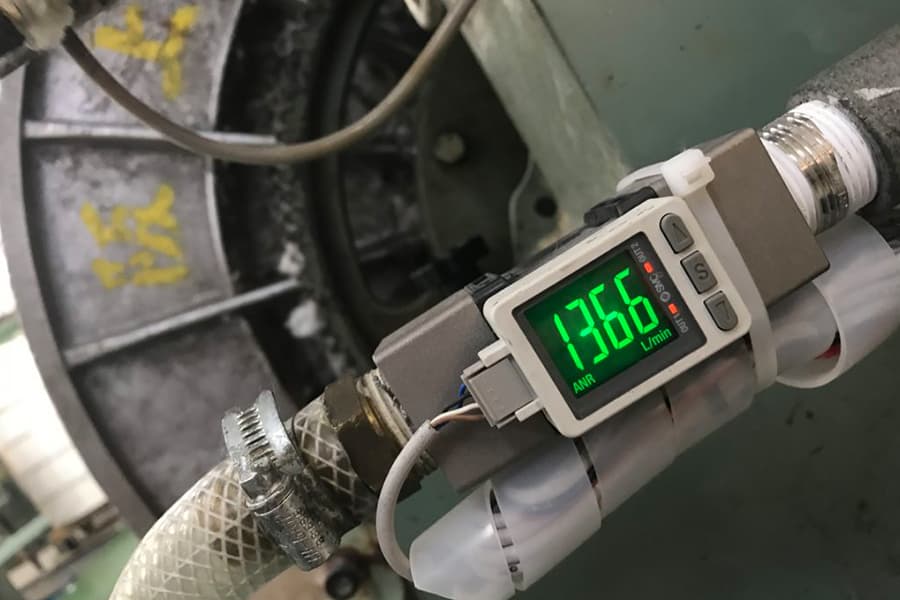
We monitor compressed-air consumption across the whole plant, by production line, and loom by loom. This data is essential for calculating accurate CO2 emissions for each fabric lot and for providing evidence of our reductions. Using it, we fine-tune part precision and operating methods. When consumption at the looms goes down, we lower the set pressure at the source—the compressors—by another notch. By repeating this loop of “improve at the end point, readjust at the source,” we keep chipping away at our environmental impact.
③ Managing airflow and heat across the plant.
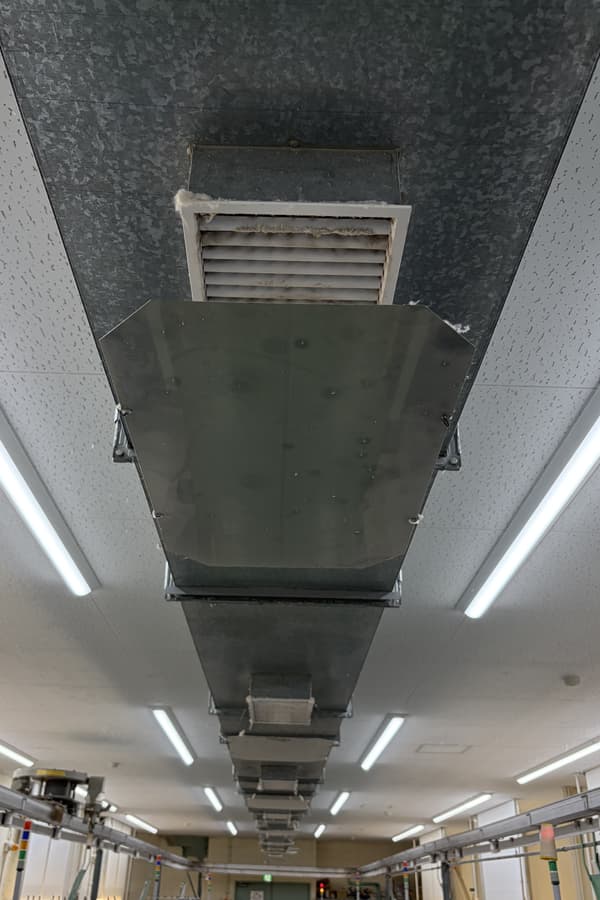
We have also refined the design of the plant itself. Beyond improving roof insulation and upgrading air-conditioning equipment, we control the large-scale convection of air and conduction of heat inside the plant, keeping the energy load of air conditioning low.
Replacing equipment, rethinking components, revising how we operate—step by step, what began as technical curiosity came to mean practicing sustainability. Today, reducing our environmental impact and disclosing the numbers is part of our very responsibility as a company.
Our Results in Numbers
Electricity consumption down 22.8% in seven years
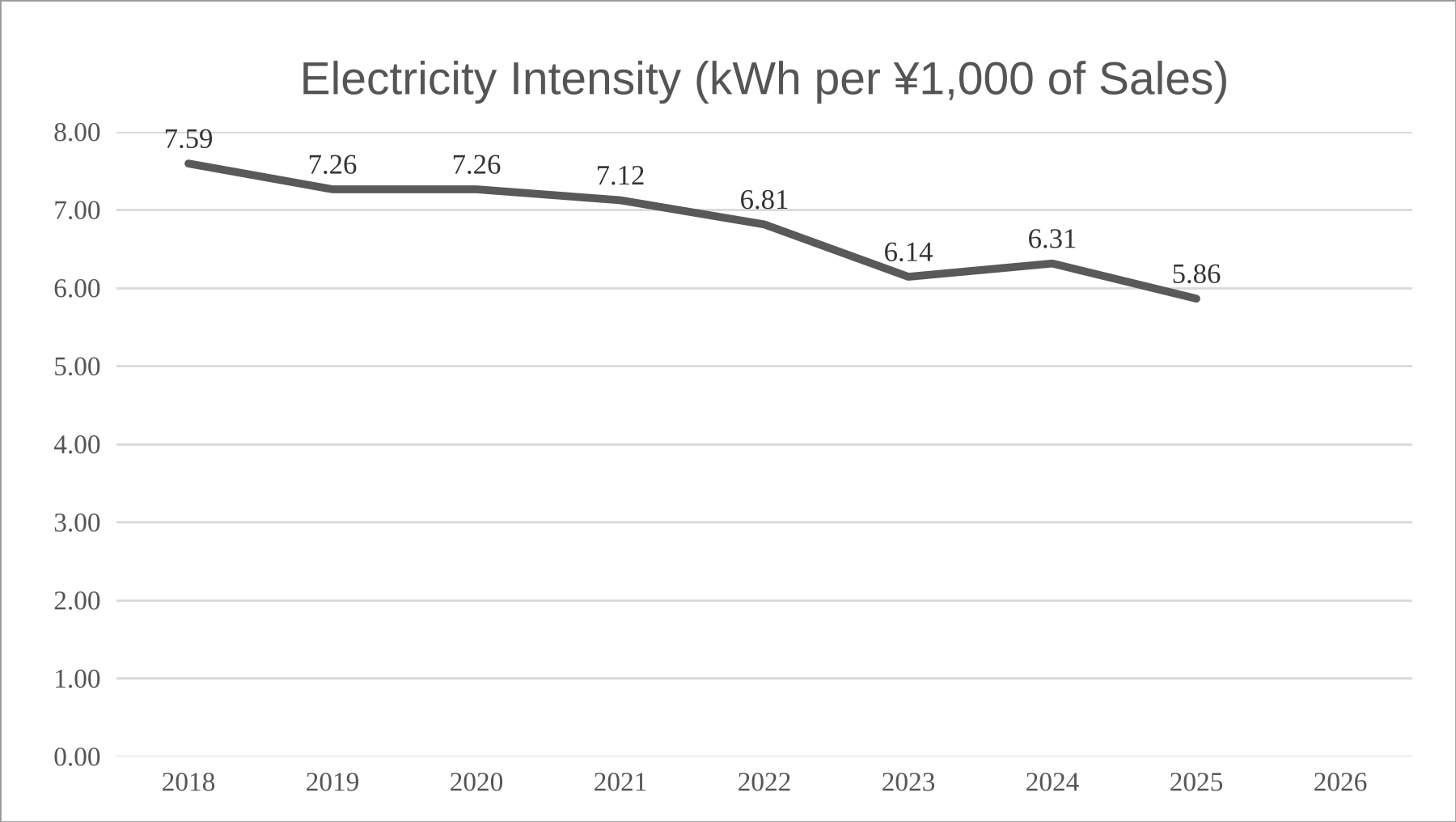
Through a series of energy-saving measures and operational improvements, our electricity consumption (power consumption per ¥1,000 of sales) fell 22.8%—from 7.59 kWh to 5.86 kWh—between 2018 and 2025, the period for which we have records.
That works out to an improvement of about 3.3% a year. Japan’s Energy Conservation Act asks businesses that use the equivalent of 1,500 kl or more of crude oil a year to make a best effort to reduce their energy intensity by an average of at least 1% a year over the medium to long term. We are too small to be covered by the Act, but by acting voluntarily we have improved at more than three times that pace.
- Source: Agency for Natural Resources and Energy, “Overview of the Energy Conservation Act” (Japanese)
- Source: Organization for Small & Medium Enterprises and Regional Innovation, J-Net21, “How Is Energy Intensity Related to Energy Saving?” (Japanese)
| Fiscal year | Electricity intensity (kWh per ¥1,000 of sales) |
What we did on the shop floor |
|---|---|---|
| 2015 | (Before measurement) | Adopted components that reduce compressed-air use on the looms (approx. 10% less power) |
| 2017 | (Before measurement) | Replaced all high-pressure compressors with inverter-driven models |
| 2018 | 7.59 | Revised the operation of compressed-air piping and air-conditioning |
| 2019 | 7.26 | Started monitoring power (compressed-air) use on every loom |
| 2020 | 7.26 | Installed components that make air use more precise on all looms (5–10% less power) |
| 2021 | 7.12 | Introduced a sectional warping machine (less product waste) / Began installing the latest energy-efficient looms |
| 2022 | 6.81 | Finished installing 13 state-of-the-art energy-efficient looms |
| 2023 | 6.14 | Gains from earlier investment and operational improvements took hold |
| 2024 | 6.31 | — |
| 2025 | 5.86 | Added more components that improve air-consumption efficiency (8–10% less power) |
| 2026 | (In progress) | [Circular economy] Began developing biodegradable materials and preparing to test a water-saving process |
* Electricity consumption = annual electricity consumption ÷ annual net sales (kWh per ¥1,000). Production fell sharply in FY2020 due to COVID-19.
We have also started collecting data on electricity use per kilogram of fabric (kWh/kg).
Environmental data for every lot
For each product and each lot, we can provide customers with the following information:
- Manufacturer
- Sakaue Weaving, Osaka, Japan
- Environmental record
- Eight years of reduction data
- Raw material lot
- Yarn type and where the raw cotton was grown
- Energy management record
- Representative electricity use for the lot (kWh/kg), CO2 equivalent (kg-CO2/kg), and water use
- Our commitments for the future
- Progress on biodegradable materials, on the water-saving process trial, and on giving discarded fabric a new use
Start with a simple question—“Could we make this visible?”—and let’s take it from there, together.
Converted to CO2
Converted to CO2, our FY2025 electricity use (about 1.48 million kWh) comes to roughly 585 t-CO2, or about 2.3 kg-CO2 per ¥1,000 of sales.
- Source: The Kansai Electric Power Co., “Power Source Composition and CO2 Emission Factors” (Japanese)
We expect these numbers to keep falling over the long term. We will show the results of our efforts as they are, with nothing glossed over—that is what we mean by transparent manufacturing.
Just by Weaving:
Saving 30 Tons of Water and Cutting CO2
Our core craft—how we weave—also has the power to dramatically reduce environmental impact.
① Weaving without sizing:
ultra-high-density textiles that save water and energy
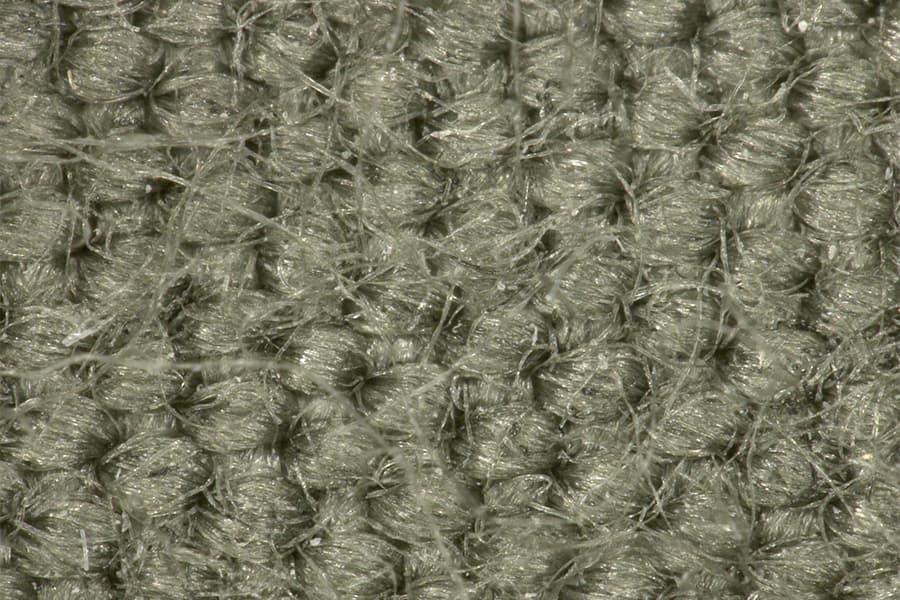
For plain weaves using 40s cotton yarn, about 230 threads per inch (warp and weft combined) was long considered the limit. Using our own mechanism that keeps friction to a minimum, we have reached 280 threads per inch—20% more. The greatest strength of this ultra-high-density textile is that it is designed from the start for zero sizing: no PVA (polyvinyl alcohol) size, which is normally applied to keep yarns from breaking during weaving.
In conventional processes that use PVA, both sizing and desizing—washing the size out before dyeing (scouring)—use water as if it were free, not to mention the heavy oil burned in boilers to make steam.
So what would the environmental cost be if we used PVA on our 80/2 cotton ultra-high-density broadcloth? Let’s run the numbers for a 10,000-meter run.
Width: 50 in.Length: 10,000 mTotal warp weight: approx. 1,328 kg(ends × picks per inch)
[Sizing]
Water absorbed by the yarn, residual size liquor, boiler and cleaning water and so on add up to about 5 tons of water, plus about 140 liters of heavy oil for drying.
[Desizing]
At the dyeing plant, washing out the PVA and keeping it from redepositing takes about 25 tons of water—roughly five times as much as sizing—plus about 350 liters of heavy oil to heat the wash water and dry the fabric.
In other words, our no-sizing process doesn’t just save 5 tons of water and 140 liters of heavy oil at our own mill. It also completely eliminates the 25 tons of water and 350 liters of heavy oil that would otherwise be used downstream at the dyeing plant.
Altogether, that is a saving of 30 tons of water and about 490 liters of heavy oil (about 1.3 tons of CO2) for every 10,000 meters.
While it tends to get overshadowed by news of savings this large, here is a word on how our ultra-high-density textile has evolved. When we started in 2010, it was so dense that dye wouldn’t penetrate—quite a surprise. By lowering the thread density by 5%, from 280 to 265, we have improved how it performs in downstream processing.
Width: 50 in.Plain weave
In its Guidelines for Environmentally Conscious Design of Textile Products, METI promotes reducing process waste, making products that last longer, and cutting the use of hazardous chemicals.
Today, the apparel and textile industries are under intense pressure to reduce their environmental impact not only within each company but across the entire supply chain (Scope 3). For dyeing and finishing plants, treating wastewater laden with PVA is also a huge burden in cost and energy. Going PVA-free—and ideally size-free—is something we want to push forward not because policy demands it, but because it is our responsibility as a weaving mill.
Let’s push it forward together.
② Fabric that lasts:
multilayer weaving that prevents degradation
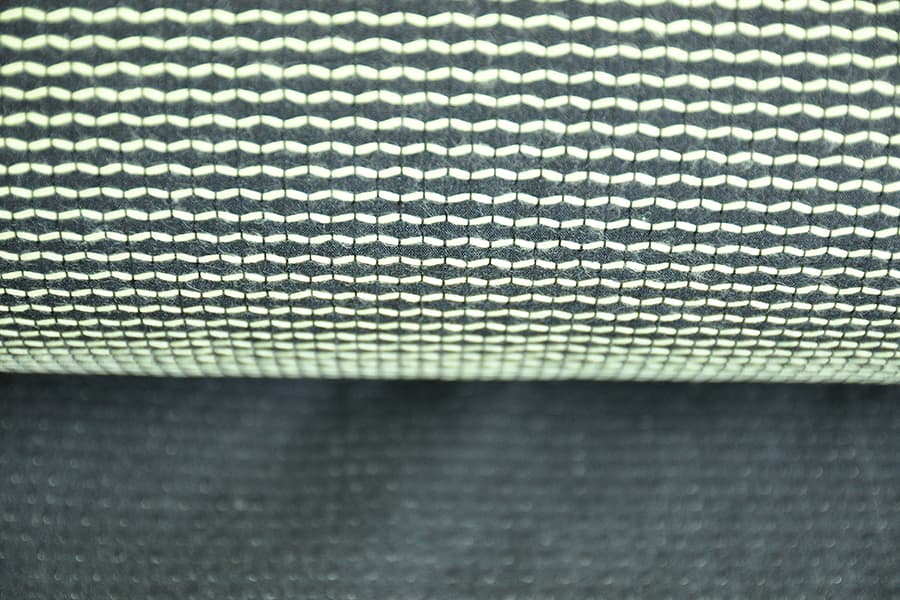
Some high-performance super fibers degrade easily under ultraviolet light. We have developed a multilayer weaving technique that locks these fibers inside the fabric to protect them, and it is used in firefighter gear and other applications. Durable, long-lasting fabric means fewer replacements and less waste—an environmental measure that hits the bullseye.
③ No wasted yarn:
a sectional warping machine and visible losses
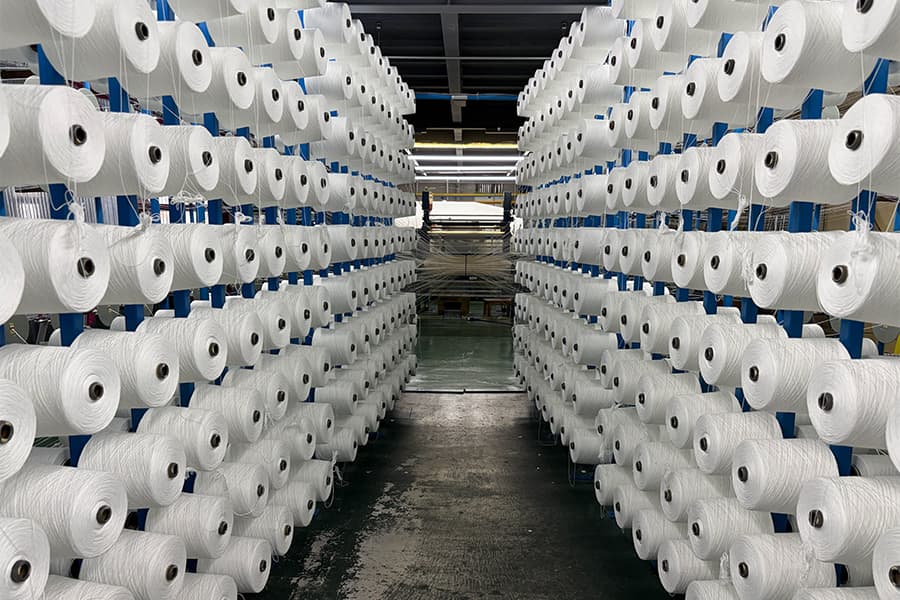
In 2012 we built a system that inspects fabric as it is being produced, and in 2021 we introduced a sectional warping machine that prepares only as much warp yarn as we need. This has cut losses in the warping process by about 3%.
Bringing warping—once outsourced—in-house and within arm’s reach has sparked new conversations, including with students, about how to use what used to be thrown away. Our drive to reduce waste is only gaining momentum.
Keeping Our Textile Region Alive:
Turning Skill into Technology
Keeping alive the textile region that supports our work matters just as much.
This area has been a weaving center since the Edo period, long known for “Izumi cotton.”
But in 2020, COVID-19 forced one of the three local companies that handled warp preparation to close. If nothing changed, the whole region’s production capacity would shrink. Alarmed, we moved up our plans to install a sectional warping machine. We didn’t do it only for ourselves—filling the gap left in the region’s production chain was very much part of our thinking.
- Source: Journal of the Japan Research Association for Textile End-Uses (Sen’i Seihin Shohi Kagaku), Vol. 62, No. 10, supplement
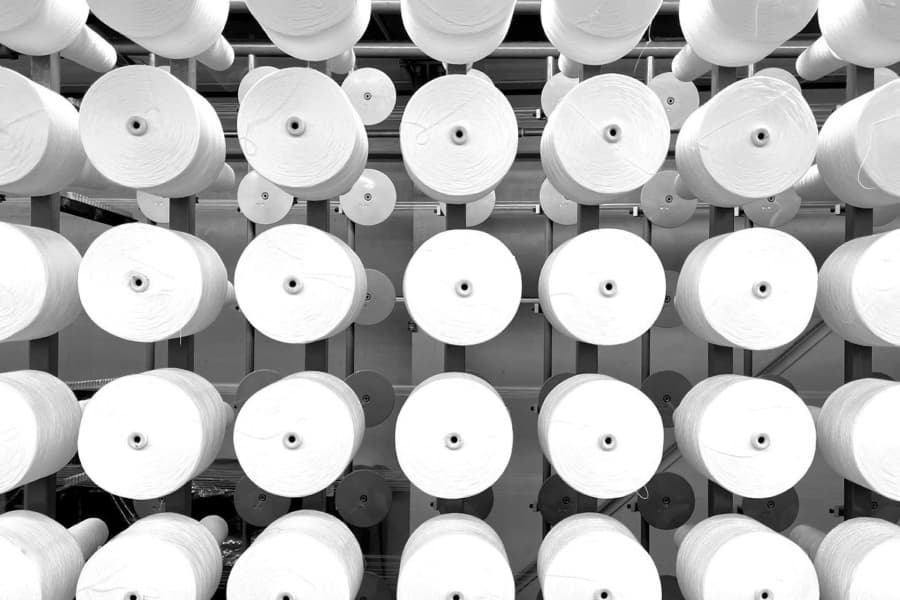
To carry our region and our craft into the future, we have worked since 2010 under one banner: turning skill into technology.
What we once called “technology” was mostly skill—know-how that lived in veteran weavers’ experience. It took a long time to reproduce, it caused significant product waste, and above all, our most skilled craftspeople were getting on in years. We were deeply worried about how to pass it on.
Strangely enough, once we put “turning skill into technology” into words as a slogan, things started moving in that direction.
Whenever we figured out the principle behind something, we built it into a jig or a part, so that anyone using that jig would have the theory built in. One by one, we opened up the black boxes. Once skill had become technology, the reproducibility of our fabrics rose dramatically.
Does that mean human skill is no longer needed? Not at all. The final, delicate adjustments still depend on it.
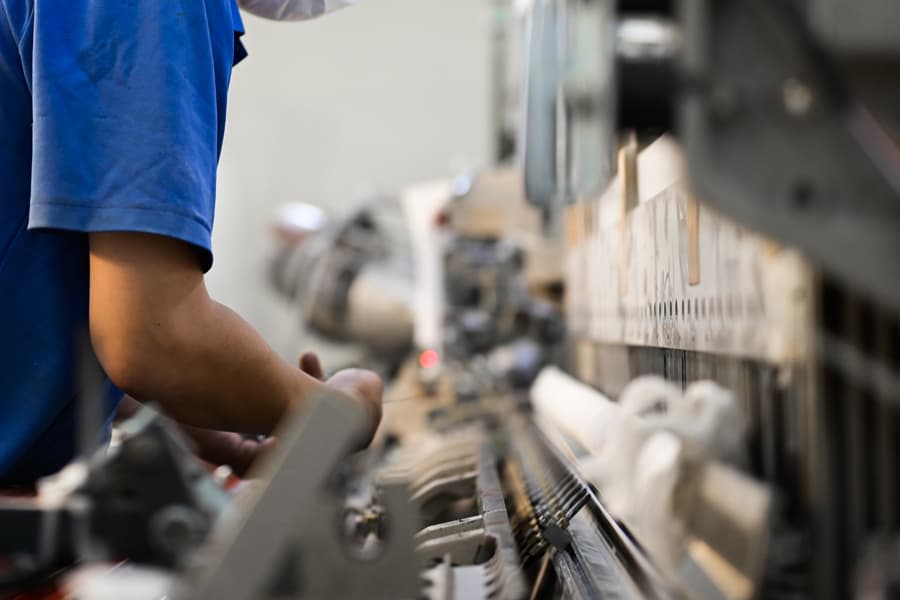
If craft only flows one way, from veteran weavers to young people, it grows stale. Young people are in tune with the world around them and bring a fresh sensibility that veteran weavers don’t have. That is exactly why they should lead the direction our technology takes (with the president taking responsibility, of course).
I believe this is the key to making things in a way that fits the values of the times ahead—and I see it playing out in front of me every day on the mill floor. “Now this is what a modern workplace looks like,” I find myself thinking. When veteran weavers and young people teach and learn from each other with mutual respect, our technology is refined along with its direction, passed on and updated in turn.
A side note: after many years on the shop floor alongside my colleagues, I can’t help smiling at how true it is that skill grows along with character. I can’t quite explain it, but the relationship between passing on a craft, developing skill and character formation is fascinating.
Next:
Manufacturing That Comes Full Circle
We are moving toward manufacturing in which materials circulate. We are taking a fresh look at how we use naturally derived raw materials and rethinking how we make things. We see three responsibilities here: to widen the possibilities of natural materials, to use things again, and to make the switch to that recycling mindset. That means looking beyond convention to broaden how we interpret materials, giving fabric that has served its purpose a second life as a resource, and trying different natural materials to achieve a breakthrough. These efforts are starting to take shape.
| When | Initiatives and goals |
|---|---|
| 2026 |
* Details of each are confidential for intellectual property reasons |
| 2027 |
|
| 2028 |
|
| 2030 |
|
A word on our biodegradable material. Many so-called biomass materials don’t actually break down; we are developing one that truly does. Along the way, we realized something: if a material is biodegradable, then by its very nature it can be developed right next to someone cooking. There’s no need to overthink it. The kitchen is our lab—although my wife scolds me when I don’t clean up.
Why not work on it with us?
As for reusing discarded fabric, we are on track to bring the results to market in 2027. It will also help make better use of local resources.
We are also pursuing research and development we call “expanding weave structures”—extending the basic weaves found in every textbook, along with the conventional thinking everyone takes for granted. It builds on our ultra-high-density technology and uses no PVA. As of 2026, we are carrying out physical-property testing with universities and other research institutions.
Message from the President
Practical, Modest, Easy to Understand—
and Harmful to No One
Motohiko Sakaue, President
Looms have evolved to make fabric faster, cheaper and in greater volume. The mill with the newest looms always wins—it’s a game rigged in favor of whoever invests last. So we chose a different path: to become specialists in how fabric is woven.
Built on the same foundation as our ultra-high-density textiles and our technology for weaving dissimilar materials together, our energy-saving know-how as a textile mill has taken on a new meaning—care for the environment—thanks to a value that is at once new and old: sustainability.
We live in an age when the right answers seem to be crumbling. Climate change and the breakneck pace of technology are overturning one assumption after another. Amid all this, the right way to make things is being shaken and called into question, too.
Faced with problems this big, the energy savings and environmental care that a single mill can build up are powerless on their own; they won’t change the world. But we can keep refining ways to strip out waste, show the impact we’ve reduced in hard numbers, and put all of it to use responsibly. We want to do everything we can.
Our goal is a process that is simple and makes sense: practical, modest, easy to understand, and harmful to no one. We will sincerely build up the right practices within our own control, and make them visible. We take responsibility for how we make things, and we are committed to transparency in manufacturing. We propose “honest manufacturing” as the right answer for how things should be made.
For example, if you find yourself thinking, “We’re throwing this away—could it be used for something?”, get in touch. Let’s work out together what we can do now, and what we might be able to do next.
Motohiko Sakaue, President
To Our Partners (Brands and Designers)
We are looking for partners to help bring a simple, sensible way of making things to life.
Our work on energy saving and environmental care, which began with simple curiosity, is now moving into its next phase: bringing biodegradable materials into woven fabric, and zero-sizing weaving that uses no PVA at all.
But we cannot make these new methods a real option—let alone the norm—on our own. It would simply take too long. We believe the true strength of Japanese manufacturing lies in bringing different kinds of expertise together and working as one toward a shared goal. When people with the same ambition join forces, we get there faster.
That is why we are looking for three kinds of partners who will use our mill as a testing ground and create new standards with us.
① Apparel brands and companies
(co-creation brand partners)
Let’s bring test lots to life together—from coatings using the new biodegradable material we are developing to fabrics made by size-free weaving.
Join us from the earliest stages of development, and once the material is complete, we can supply it to you as an exclusive sustainable material. Armed with solid Scope 3 (supply chain emissions) reduction data and a transparent story that starts at the mill, let’s create new value together.
② Universities, research institutions and chemical manufacturers
(technology and research partners)
We offer our mill as a field for test production, so the new biodegradable resins and eco-materials in your lab can be tried on real looms and real fabric.
Taking theory from the beaker to the production floor always brings challenges—viscosity control, adhesion to fibers and more—that you can only discover by actually combining materials. By pairing your expertise in polymer chemistry and resin development with our hands-on weaving know-how, we want to overcome those challenges and build new patents (intellectual property) together on the road to commercialization.
③ Government bodies, support organizations and ESG investors
(implementation and scale-up partners)
A traditional Japanese textile business that meets European environmental regulations such as the Digital Product Passport (DPP) while achieving zero PVA discharge and dramatic water savings—please help us bring this model case to society.
The seeds of this technology are taking root. If you can help us clear the hurdles a small business faces, such as capital investment and IP strategy, we will establish a world-class model of environmentally conscious manufacturing right here in Senshu.
Start with a simple question—“Could we do something like this?”—and let’s take it from there, together.
References (External Links)
- Ministry of the Environment, “Sustainable Fashion” (Japanese)
- METI, Guidelines for Environmental Information Disclosure in the Textile and Apparel Industry (1st Edition), June 2024 (Japanese)
- METI, Guidelines for Environmentally Conscious Design of Textile Products, March 2024 (Japanese)
- METI, Roadmap for Resource Circulation in Textile Products, June 2024 (Japanese)
- METI, Report of the Study Group on Sustainability in the Textile Industry, 2021 (Japanese)
- Agency for Natural Resources and Energy, “Overview of the Energy Conservation Act” (Japanese)
- Organization for Small & Medium Enterprises and Regional Innovation, J-Net21, “How Is Energy Intensity Related to Energy Saving?” (Japanese)
- Small and Medium Enterprise Agency, 2024 White Paper on Small and Medium Enterprises in Japan, Section 5: GX (Japanese)
- Ministry of the Environment et al., Roadmap for the Introduction of Bioplastics, 2021 (Japanese)
- Senshu Textile Industry Cooperative (Japanese)
- The Kansai Electric Power Co., “Power Source Composition and CO2 Emission Factors” (Japanese)